“In the gospel race there are no losers, only quitters.”
| Believing Christ

LDS Quotes on Attitude
“In the gospel race there are no losers, only quitters.”
| Believing Christ
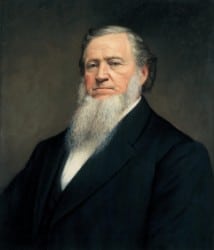
“No matter what your circumstances are, whether you are in prosperity or in adversity, you can learn from every person, transaction, and circumstance around you.”

It’s really a wonder that I haven’t dropped all my ideals, because they seem so absurd and impossible to carry out. Yet I keep them, because in spite of everything, I still believe that people are really good at heart.

| Jesus Christ Is the Strength of Youth
“A story is told of an encounter between the Prophet Joseph Smith and Brigham Young. In the presence of a rather large group of brethren, the Prophet severely chastised Brother Brigham for some failing in his duty. Everyone, I suppose somewhat stunned, waited to see what Brigham’s response would be. After all, Brigham, who later became known as the Lion of the Lord, was no shrinking violet by any means. Brigham slowly rose to his feet, and in words that truly reflected his character and his humility, he simply bowed his head and said, “Joseph, what do you want me to do?” The story goes that sobbing, Joseph ran from the podium, threw his arms around Brigham, and said in effect, “You passed, Brother Brigham, you passed.”
| “Hugh B. Brown – Youthful Veteran,” New Era, April 1976, p. 16

“Forgiveness is not an occasional act, it is a constant attitude.”
“There is also a dimension of patience which links it to a special reverence for life. Patience is a willingness, in a sense, to watch the unfolding purposes of God with a sense of wonder and awe, rather than pacing up and down within the cell of our circumstance. Put another way, too much anxious opening of the oven door and the cake falls instead of rising. So it is with us. If we are always selfishly taking our temperature to see if we are happy, we will not be…When we are impatient, we are neither reverential nor reflective because we are too self-centered. Whereas faith and patience are companions, so are selfishness and impatience. It is so easy to be confrontive without being informative; so easy to be indignant without being intelligent; so easy to be impulsive without being insightful. It is so easy to command others when we are not in control of ourselves.”
| Patience, BYUDA 11/79
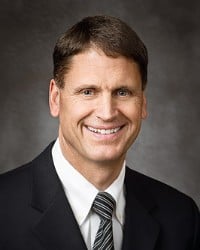
“At the end of a particularly tiring day toward the end of my first week as a General Authority, my briefcase was overloaded and my mind was preoccupied with the question “How can I possibly do this?” I left the office of the Seventy and entered the elevator of the Church Administration Building. As the elevator descended, my head was down and I stared blankly at the floor.
“The door opened and someone entered, but I didn’t look up. As the door closed, I heard someone ask, “What are you looking at down there?” I recognized that voice—it was President Thomas S. Monson.
“I quickly looked up and responded, “Oh, nothing.” (I’m sure that clever response inspired confidence in my abilities!)
“ But he had seen my subdued countenance and my heavy briefcase. He smiled and lovingly suggested, while pointing heavenward, “It is better to look up!” As we traveled down one more level, he cheerfully explained that he was on his way to the temple. When he bid me farewell, his parting glance spoke again to my heart, “Now, remember, it is better to look up.”
| "It Is Better to Look Up," Conference October 2011
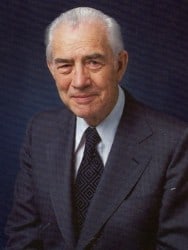
“We can readily see that observance of the Sabbath is an indication of the depth of our conversion. Our observance or nonobservance of the Sabbath is an unerring measure of our attitude toward the Lord personally and toward his suffering in Gethsemane, his death on the cross, and his resurrection from the dead. It is a sign of whether we are Christians in very deed, or whether our conversion is so shallow that commemoration of his atoning sacrifice means little or nothing to us.”
| “The Sabbath Day,” Ensign, May 1975, 49.
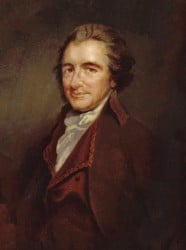
“I love the man who can smile in trouble, who can gather strength in distress and grow brave by reaction. It is the business of little minds to shrink, but he whose heart is firm, and whose conscience approves his conduct, will pursue his principles to the death.”

“In the depths of winter I finally learned there was in me an invincible summer.”
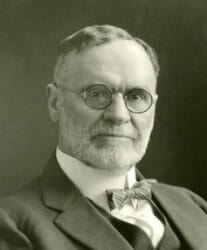
“The Spirit of the gospel is optimistic; it trusts in God and looks on the bright side of things. The opposite or pessimistic spirit drags men down and away from God, looks on the dark side, murmurs, complains, and is slow to yield obedience.”
| Conference Report, April 1917
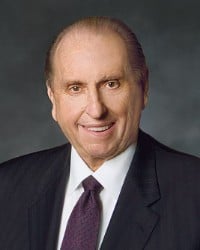
“We can lift ourselves, and others as well, when we refuse to remain in the realm of negative thought and cultivate within our hearts an attitude of gratitude. If ingratitude be numbered among the serious sins, then gratitude takes its place among the noblest of virtues.”
| "An Attitude of Gratitude"
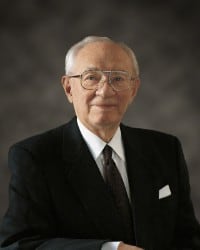
“Cultivate an attitude of happiness. Cultivate a spirit of optimism. Walk with faith, rejoicing in the beauties of nature, in the goodness of those you love, in the testimony which you carry in your heart concerning things divine.”
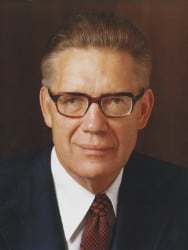
“Death can be comforting and sweet and precious or it can thrust upon us all the agonies and sulphurous burnings of an endless hell. And we—each of us individually—make the choice as to which it shall be.”
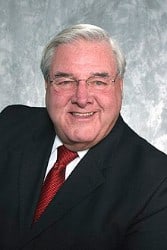
“Attitude is a choice. Happiness is a choice. Optimism is a choice. Kindness is a choice. Giving is a choice. Respect is a choice. Whatever choice you make makes you. Choose wisely.”
| The Light in the Heart
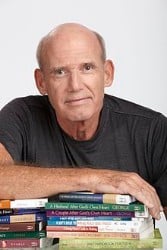
“The basic question is not how much of our money we should give to God, but how much of God’s money we should keep for ourselves.”
| A Husband After God's Own Heart
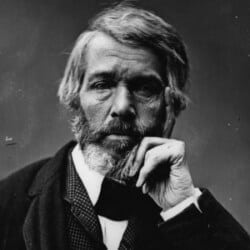
“The greatest of all faults is to be conscious of none.”
“Too many who come to marriage have been coddled and spoiled and somehow led to feel that everything must be precisely right at all times, that life is a series of entertainments, that appetites are to be satisfied without regard to principle. How tragic the consequences of such hollow and unreasonable thinking! …”
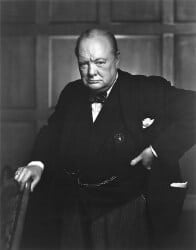

“If our testimonies are strong on this point and if we feel the absolute assurance that God loves us, we will change our questions. We won’t ask, ‘Why did this happen?’ or ‘Why doesn’t God care about me?’ Instead, our questions will become, ‘What can I learn from this experience?’ or ‘How does the Lord want me to handle this?”
| When Times Are Tough: 5 Scriptures That Will Help You Get Through Almost Anything

“If you don’t like something, change it. If you can’t change it, change your attitude.”
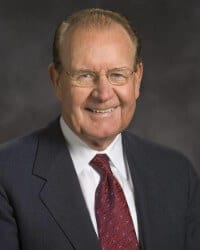
“Sometimes we find that even when we do our best to serve God, we still suffer. The key is to remember that faith and obedience are still the answers – even when things go wrong, perhaps especially when things go wrong.”
“It is possible to be honest every day. It is possible to live so that others can trust us-can trust our words, our motives, and our actions. Our examples are vital to those who sit at our feet as well as those who watch from a distance. Our own constant self-improvement will become as a polar star to those within our individual spheres of influence. They will remember longer what they saw in us than what they heard from us. Our attitude, our point of view, can make a tremendous difference.”
| Standing for Something: Ten Neglected Virtues That Will Heal Our Hearts and Homes

“While I was working for a large bank, I was invited to attend an executive program at the University of Michigan. During the program, Professor Kim Cameron taught the concept of positive leadership and its heliotropic effect. He explained: “This refers to the tendency in all living systems toward positive energy [light] and away from negative energy [darkness]. From single-cell organisms to complex human systems, everything alive has an inherent inclination toward the positive and away from the negative.”
| "Brighter and Brighter until the Perfect Day"
“To make ourselves happy is incorporated in the great design of man’s existence. I have learned not to fret myself about that which I cannot help. If I can do good, I will do it; and if I cannot reach a thing, I will content myself to be without it. This makes me happy all the day long.”
| Journal of Discourses, 2:95

“I am still determined to be cheerful and happy, in whatever situation I may be; for I have also learned from experience that the greater part of our happiness or misery depends upon our dispositions, and not upon our circumstances.”
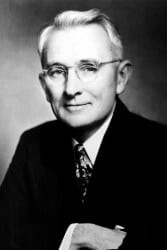
“It isn’t what you have or who you are or where you are or what you are doing that makes you happy or unhappy. It is what you think about it.”
| How to Win Friends and Influence People

How much we know ourselves is extremely important but how we treat ourselves is the most important.
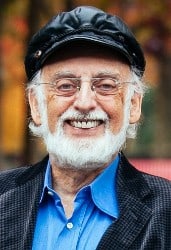
“Those in happy marriages noticed almost all of the positive things their partners did for them, while those in unhappy marriages failed to recognize 50% of the positive acts their spouses performed.”
| (1999). The seven principles for making marriage work. New York: Three Rivers Press.
“I am satisfied that if we would look for the virtues in one another and not the vices, there would be much more of happiness in the homes of our people. There would be far less of divorce, much less of infidelity, much less of anger and rancor and quarreling. There would be more of forgiveness, more of love, more of peace, more of happiness. This is as the Lord would have it.”
| Living Worthy of the Girl You Will Someday Marry
“Willingness to experience difficult thoughts, feelings, and experiences is put in the service of our values. This is what makes willingness different from wallowing”
| S. C., & Walser, R. D. (2007). Learning ACT: An acceptance & commitment therapy skills-training manual for therapists. Oakland, CA: New Harbinger Publications.
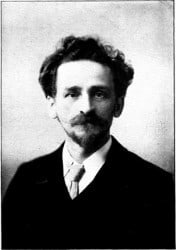
“The will to do springs from the knowledge that we can do. He who has conquered fear has conquered failure.”
| As a Man Thinketh
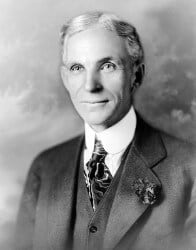
“If you think you can or you think you can’t, you’re right.”

“Being mistreated is the most important condition of mortality, for eternity itself depends on how we view those who mistreat us.”
| The Peacegiver: How Christ Offers to Heal Our Hearts and Homes
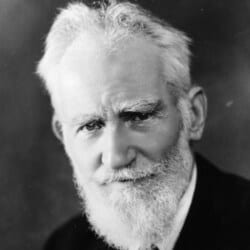
“People are always blaming their circumstances for what they are. I don’t believe in circumstances. The people who get on in this world are the people who get up and look for the circumstances they want, and, if they can’t find them, make them.”
| Mrs. Warren’s Profession, in Plays by George Bernard Shaw, New York: New American Library, 1960, p. 82.
“We can’t direct the wind, but we can adjust the sails. For maximum happiness, peace, and contentment, may we choose a positive attitude.”
| “Living the Abundant Life,” Ensign, January 2012, p. 4
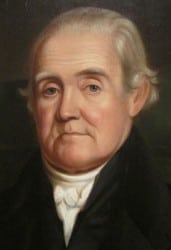
“From having wishes in consequence of our wants, we often feel wants in consequence of our wishes.”
| American Dictionary of the English Language (San Francisco: The Foundation for American Christian Education, 1987)

“I love those who can smile in trouble…”
“It is reported that President Brigham Young once said that he who takes offense when no offense was intended is a fool, and he who takes offense when offense was intended is usually a fool.”
| Ensign, January 1974, p. 21
“Many Latter-day Saints know the Church is true but have unhealthy feelings about their own inadequacies, real or imagined. The scriptures inform us that we all have weaknesses and that there is a place for them in our spiritual progress: “If men come unto me I will show unto them their weakness. I give unto men weakness that they may be humble; and my grace is sufficient for all men that humble themselves before me; for if they humble themselves before me, and have faith in me, then will I make weak things become strong unto them” (Ether 12:27)…Too often we wallow in our weaknesses so much that we do not allow “weak things” to “become strong.” Our condition is frequently misdiagnosed as humility, when in reality it is a lack of confidence…What is the difference between the two? To be humble is to recognize our utter dependence upon the Lord. We are conscious of our strengths, but we do not exalt ourselves and become prideful, for we know that all good things ultimately come from God. We are conscious of our weaknesses, but we know the Lord can use those very weaknesses to bless our lives and that through Him, as we learn from the book of Ether, our weaknesses can become strengths…To lack confidence is to have feelings of low self-worth. We are preoccupied with our weaknesses, and we lack faith in the Lord’s ability to use those weaknesses for our good. We do not understand our inestimable worth in the eyes of God, nor do we appreciate our divine potential. Ironically, both pride and a lack of self-confidence cause us to focus excessively on ourselves and to deny the power of God in our lives.”
| “Confidence and Self-Worth,” Ensign, January 2005, pp. 32-35
“One of my favorite newspaper columnists is Jenkin Lloyd Jones. In a recent article published in the News, he commented: ‘There seems to be a superstition among many thousands of our young who hold hands and smooch in the drive-ins that marriage is a cottage surrounded by perpetual hollyhocks, to which a perpetually young and handsome husband comes home to a perpetually young and ravishing wife. When the hollyhocks wither and boredom and bills appear, the divorce courts are jammed. Anyone who imagines that bliss is normal is going to waste a lot of time running around shouting that he’s been robbed. The fact is that most putts don’t drop. Most beef is tough. Most children grow up to be just ordinary people. Most successful marriages require a high degree of mutual toleration. Most jobs are more often dull than otherwise. …Life is like an old-time rail journey — delays, sidetracks, smoke, dust, cinders, and jolts, interspersed only occasionally by beautiful vistas and thrilling bursts of speed. The trick is to thank the Lord for letting you have the ride.’”
| "God Shall Give Unto You Knowledge by His Holy Spirit"
| “Living the Abundant Life,” Ensign, Jan. 2012, 4.

“God expects you to have enough faith and determination and enough trust in Him to keep moving, keep living, keep rejoicing. In fact, He expects you not simply to face the future (that sounds pretty grim and stoic); He expects you to embrace and shape the future — to love it and rejoice in it and delight in your opportunities.”
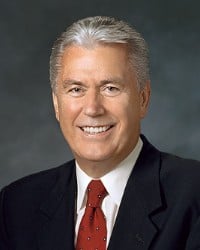
“An old proverb says, ‘The best time to plant a tree is 20 years ago. The second-best time is now.’
“There is something wonderful and hopeful about the word now. There is something empowering about the fact that if we choose to decide now, we can move forward at this very moment.
“Now is the best time to start becoming the person we eventually want to be—not only 20 years from now but also for all eternity.”
| The Best Time to Plant a Tree
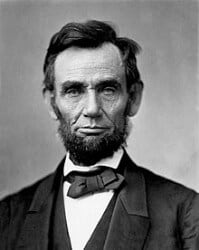
“Most folks are about as happy as they make up their minds to be.”
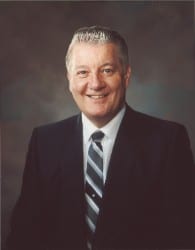
“Sometimes the Lord calms the storm, and sometimes he lets the storm rage and calms the child.”
“The Lord has probably spoken enough comforting words to supply the whole universe, and yet all we see around us are unhappy Latter-day Saints, worried Latter-day Saints, and gloomy Latter-day Saints into whose troubled hearts not one of these innumerable consoling words seems to be allowed to enter . . . on the night of Gethsemane, the night of the greatest suffering ever to take place on this world, the Savior said, “Peace I leave with you, my peace I give unto you . . . let not your heart be troubled, neither let it be afraid” (John 14:27). I submit to you, that may be one of the Savior’s commandments that is, even in the hearts of otherwise faithful Latter-Day Saints, almost universally disobeyed.”
| CES Young Adult Fireside, BYU, March 2, 1997