Maturity

“Living the gospel does not mean the storms of life will pass us by, but we will be better prepared to face them with serenity and peace. ‘Search diligently, pray always, and be believing,’ the Lord admonished, ‘and all things shall work together for your good, if ye walk uprightly.'”

Joseph B. Wirthlin  |  "Finding a Safe Harbor," Ensign, May 2000, 59

Topics: , , , ,

“The habit of saying thank you is the mark of a cultivated mind.”

Gordon B. Hinckley  |  Way to Be!: 9 Rules For Living the Good Life

Topics: , , ,

“Everyone should learn something new everyday. You all have inquiring minds and are seeking truth in many fields. I sincerely hope your greatest search is in the realm of spiritual things, because it is there that we are able to gain salvation and make the progress that leads to eternal life in our Father’s kingdom. The most important knowledge in the world is gospel knowledge. It is knowledge of God and his law, of those things that men must do to work out their salvation with fear and trembling before the Lord.”

Joseph Fielding Smith  |  Ensign, May 1971, pp. 2-3

Topics: , , , , , ,

“True religion is not a matter of intellectuality or of worldly prominence or renown, but of spirituality.”

Bruce R. McConkie  |  Doctrinal New Testament Commentary (Salt Lake City: Bookcraft, 1971), 2:316

Topics: , ,

“Reverence is the soul of true religion. It’s seedbed is sincerity. Its quality is determined by the esteem in which one holds the object of his reverence as evidenced by his behavior toward that object. When that object is God, the genuinely reverent person has a worshipful adoration coupled with a respectful behavior toward him and all that pertains to him. The want of such appreciation or behavior smacks of irreverence. Order is a part of reverence. So is cleanliness of person, of apparel, of speech, of action, and of thought and impulse. So also are courtesy, respect for one another, and kindred virtues. Reverence is a sign of spiritual maturity, strength, and nobility.”

Marion G. Romney  |  Ensign, Oct. 1976, 2

Topics: , , ,

Neal A. Maxwell Headshot

Just as the capacity to defer gratification is a sign of real maturity, likewise the willingness to wait for deferred explanation is a sign of real faith and of trust spread over time.

Elder Neal A. Maxwell  |  “Willing to Submit,” Ensign, May 1985, p. 71

Topics: , ,

“When are you old enough? Maturity may vary from individual to individual, but we are convinced that dating should not even begin until you are 16. And then, ideal dating is on a group basis. Stay in group activities; don’t pair off. Avoid steady dating. Steady dating is courtship, and surely the beginning of courtship ought to be delayed until you have emerged from your teens.”

Boyd K. Packer  |  “You’re in the Driver’s Seat,” New Era, June 2004, 8.

Topics: , ,

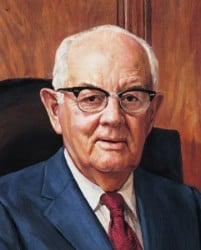
Spencer W. Kimball Portrait

“Some have no ear for spiritual messages when they come in common dress…Expecting the spectacular, one may not be fully alerted to the constant flow of revealed communication.”

Spencer W. Kimball  |  Teachings of Spencer W. Kimball, ed. Edward L. Kimball, Salt Lake City: Bookcraft, 1982, p. 457.

Topics: , ,

Neal A. Maxwell Headshot

“If we will keep our covenants, our covenants will keep us spiritually safe.”

Elder Neal A. Maxwell  |  Ensign, May 1987, p. 71

Topics: , ,

“The willingness to forgive is a sign of spiritual and emotional maturity. It is one of the great virtues to which we all should aspire. Imagine a world filled with individuals willing both to apologize and to accept an apology. Is there any problem that could not be solved among people who possessed the humility and largeness of spirit and soul to do either — or both — when needed?”

Gordon B. Hinckley  |  Standing for Something: 10 Neglected Virtues That Will Heal Our Hearts and Homes

Topics: , , ,

“We can be knowledgeable with other men’s knowledge, but we can’t be wise with other men’s wisdom. That’s because wisdom isn’t a body of information. It’s the moral quality of knowing what you don’t know and figuring out a way to handle your ignorance, uncertainty, and limitation.”

David Brooks  |  The Road to Character

Topics: , , ,

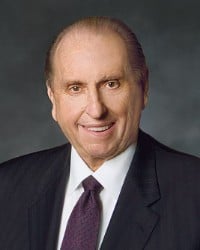
Thomas S. Monson

From [the] majestic world of spirits we enter the grand stage of life to prove ourselves obedient to all things commanded of God. During mortality we grow from helpless infancy to inquiring childhood and then to reflective maturity. We experience joy and sorrow, fulfillment and disappointment, success and failure. We taste the sweet, yet sample the bitter. This is mortality. Then to each life comes the experience known as death. None is exempt. All must pass its portals. To most, there is something sinister and mysterious about this unwelcome visitor called death. Perhaps it is a fear of the unknown which causes many to dread its coming . . . [The Savior’s] words to the grieving Martha and to His disciples today bring comfort to us:” ‘I am the resurrection, and the life: he that believeth in me, though he were dead, yet shall he live.”

Thomas S. Monson  |  “Mrs. Patton – the Story Continues,” Ensign, November 2007, pp. 22-23

Topics: , , , , ,

The constant exercise of our faith by lofty thinking, prayer, devotion, and acts of righteousness is just as essential to spiritual health as physical exercise is to the health of the body. Like all priceless things, faith, if lost, is hard to regain. Eternal vigilance is the price of our faith. In order to retain our faith we must keep ourselves in tune with our Heavenly Father by living in accordance with the principles and ordinances of the gospel.

O. Leslie Stone  |  Ensign, July 1973, p. 59

Topics: , , , ,