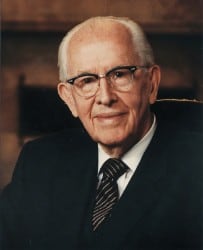
“No one adequately and properly knows why he needs Christ until he understands and accepts the doctrine of the Fall and its effect upon all mankind.”
| A Witness and a Warning

Ezra Taft Benson Quotes
“No one adequately and properly knows why he needs Christ until he understands and accepts the doctrine of the Fall and its effect upon all mankind.”
| A Witness and a Warning
“The question is sometimes asked by younger priesthood holders, ‘Where do I place my greatest priorities—to the Church, to my family, or to my profession?’ I have answered that question by emphasizing that heads of families have four major responsibilities. Certainly the first is to the home and family. There should be no question about this. A man may succeed in business or his Church calling, but if he fails in his home he will face eternity in disappointment. … Home is the place where the Lord intended a father’s greatest influence to be felt.”
| Teachings of Ezra Taft Benson, 509–10
“The sacred title of ‘father’ is shared with the Almighty. … Fatherhood is not a matter of station or wealth; it is a matter of desire, diligence and determination to see one’s family exalted in the celestial kingdom. If that prize is lost, nothing else really matters.”
“Men and women who turn their lives over to God will find out that he can make a lot more out of their lives than they can. He will deepen their joys, expand their vision, quicken their minds, strengthen their muscles, lift their spirits, multiply their blessings, increase their opportunities, comfort their souls, raise up friends, and pour out peace.”
| The Teachings of Ezra Taft Benson, p. 361
“The Holy Ghost causes our feelings to be more tender. We feel more charitable and compassionate with each other. We are more calm in our relationships. We have a greater capacity to love each other. People want to be around us because our very countenances radiate the influence of the Spirit. We are more godly in our character. As a result, we become increasingly more sensitive to the promptings of the Holy Ghost and thus able to comprehend spiritual things more clearly.”
| Ensign, April 1988
In the Book of Mormon we find a pattern for preparing for the Second Coming. A major portion of the book centers on the few decades just prior to Christ’s coming to America. By careful study of that time period, we can determine why some were destroyed in the terrible judgments that preceded His coming and what brought others to stand at the temple in the land of Bountiful and thrust their hands into the wounds of His hands and feet.
From the Book of Mormon we learn how disciples of Christ live in times of war. From the Book of Mormon we see the evils of secret combinations portrayed in graphic and chilling reality. In the Book of Mormon we find lessons for dealing with persecution and apostasy. We learn much about how to do missionary work. And more than anywhere else, we see in the Book of Mormon the dangers of materialism and setting our hearts on the things of the world. Can anyone doubt that this book was meant for us and that in it we find great power, great comfort, and great protection?”
| “The Book of Mormon – Keystone of Our Religion,” Ensign, November 1986, p. 4
“Now, brethren, do not expect perfection in your choice of a mate. Do not be so particular that you overlook her most important qualities of having a strong testimony, living the principles of the gospel, loving home, wanting to be a mother in Zion, and supporting you in your priesthood responsibilities. Of course, she should be attractive to you….And one good yardstick as to whether a person might be the right one for you is this: in her presence, do you think your noblest thoughts, do you aspire to your finest deeds, do you wish you were better than you are?”
| To the Single Adult Brethren of the Church
“The secret of a happy marriage is to serve God and each other. The goal of marriage is unity and oneness, as well as self-development. Paradoxically, the more we serve one another, the greater is our spiritual and emotional growth.”
| Fundamentals of Enduring Family Relationships
“Men and women who turn their lives over to God will find out that he can make a lot more out of their lives than they can. He will deepen their joys, expand their vision, quicken their minds, strengthen their muscles, lift their spirits, multiply their blessings, increase their opportunities, comfort their souls, raise up friends, and pour out peace.”
“Callings in the church, as important as they are, by their very nature are only for a period of time, and then an appropriate release takes place. But a father’s calling is eternal, and its importance transcends time. It is a calling for both time and eternity.”
The greatest events of history are those that affect the greatest number of people for the longest periods. By this standard, no event could be more important to individuals or nations than the resurrection of the Master. The literal resurrection of every soul who has lived and died on earth is a certainty, and surely one should make careful preparation for this event. A glorious resurrection should be the goal of every man and woman, for resurrection will be a reality. . . .As one of His latter-day witnesses, I testify that He lives today. He is a resurrected Being. He is our Savior, our Lord, the very Son of God. I testify that He will come again as our glorified, resurrected Lord. That day is not far distant. To all who accept Him as Savior and Lord, His literal resurrection means that life does not end at death, for He promised: “Because I live, ye shall live also.”
| “The Meaning of Easter,” Ensign, April 1992, pp. 2-4
“Fidelity to one’s marriage vows is absolutely essential for love, trust, and peace.”
“I would not have anyone believe that there is no hope if there are some who have made such a grievous mistake, because repentance and forgiveness are also a part of the gospel. Thank God for that! But it must be real repentance. Such repentance is a deep, heartfelt sorrow for sin that produces a reformation of life. It is not just a confession of guilt. Sometimes we regard all too lightly the principle of repentance, thinking that it only means confession, that it only means feeling sorry for ourselves. But it is more than that. It is a deep, burning, and heartfelt sorrow for sin that will drive us to our knees in humility and tears—a deep, heartfelt sorrow for sin that produces a reformation of life. That is the right test: a reformation of life. Only then may the God of heaven in his mercy and his goodness see fit to forgive us. He—not the priesthood on the earth—is the judge. Priesthood holders can only carry out certain requirements. They can require certain things set forth in the revelations, but forgiveness comes from above.”
| God, Family, Country: Our Three Great Loyalties, Salt Lake City: Deseret Book Co., 1974, p. 196
“Stewardship in the Church is a very important matter. The Lord has mentioned it in the revelations. (See D&C 59; 104.) We are stewards over these earthly blessings which the Lord has provided, those of us who have this soil and this water. We have no moral latitude, it seems to me. In fact, we are morally obligated to turn this land over to those who succeed us — not drained of its fertility but improved in quality, in productivity, and in usefulness for future generations.”
| The Teachings of Ezra Taft Benson, 645.
“To be successful, we must have the Spirit of the Lord. We have been taught that the Spirit will not dwell in unclean tabernacles. Therefore, one of our first priorities is to make sure our own personal lives are in order.”
| Come unto Christ, 92
“Pride is essentially competitive in nature. We pit our will against God’s. When we direct our pride toward God, it is in the spirit of ‘my will and not thine be done.’ As Paul said, they ‘seek their own, not the things which are Jesus Christ’s’.”
| “Beware of Pride,” Ensign, May 1989
“The proud cannot accept the authority of God giving direction to their lives. They pit their perceptions of truth against God’s great knowledge, their abilities versus God’s priesthood power, their accomplishments against His mighty works.”
| “Beware of Pride,” Ensign, May 1989
“When we put God first, all other things fall into their proper place or drop out of our lives. Our love of the Lord will govern the claims of our affection, the demands on our time, the interests we pursue, and the order of our priorities.”
| Conference Report, Apr. 1988, 13; or Ensign, May 1988, 4
“A certain kind of devil goes not out except by fasting and prayer, the scriptures tell us. (See Matt. 17:14-21.) Periodic fasting can help clear up the mind and strengthen the body and the spirit. The usual fast, the one we are asked to participate in for fast Sunday, is to abstain from food and drink for two consecutive meals. Some people, feeling the need, have gone on longer fasts of abstaining from food but have taken the needed liquids. Wisdom should be used, and this fast should be broken with light eating. To make a fast most fruitful, it should be coupled with prayer and meditation; physical work should be held to a minimum, and one should ponder on the scriptures and the reason for the fast.”
| “Do Not Despair,” Ensign, October 1986, p. 4
“Pride is a very misunderstood sin, and many are sinning in ignorance. In the scriptures there is no such thing as righteous pride—it is always considered a sin. Therefore, no matter how the world uses the term, we must understand how God uses the term so we can understand the language of holy writ and profit thereby.”
| “Beware of Pride,” Ensign, May 1989
“Pride is a sin that can readily be seen in others but is rarely admitted in ourselves.”
| “Beware of Pride,” Ensign, May 1989