Money

LDS Quotes on Money

“Interest never sleeps nor sickens nor dies; it never goes to the hospital; it works on Sundays and holidays; it never takes a vacation. … Once in debt, interest is your companion every minute of the day and night; you cannot shun it or slip away from it; you cannot dismiss it; it yields neither to entreaties, demands, or orders; and whenever you get in its way or cross its course or fail to meet its demands, it crushes you.”

J. Reuben Clark  |  Conference Report, Apr. 1938, 103.

Topics: ,

A long time ago, I took a walk down a street in Harlem in New York City. I came upon a man who asked me for a dollar. He had asked a few other people before me, but they only passed him by without glancing his way. I stopped and handed the man some money. As I began to turn away, he reached out and shook my hand. He looked me in the eyes and said, “I will bless you.” Now, I’m not saying that was God Himself. But how do we know that it wasn’t someone working for him, walking around in disguise, just to see what we would do?

Muhammad Ali  |  The Soul of a Butterfly

Topics: , , ,

“Many of our people are living on the very edge of their incomes. In fact, some are living on borrowings… I urge you to be modest in your expenditures; discipline yourselves in your purchases to avoid debt to the extent possible. Pay off debt as quickly as you can, and free yourselves from bondage.”

Gordon B. Hinckley  |  “To the Boys and to the Men,” Liahona, Jan. 1999, 65–66; Ensign, Nov. 1998, 53–54.

Topics: ,

“We would not lend a neighbor money with which to run his business without interest. Neither would we expect him to lend us money without paying interest. I found I was using God’s money and the business talents He had given me without paying Him interest. That’s all I’ve done in tithing—just met my interest obligations!”

Anonymous  |  quoted by Ernest L Wilkinson, “The Principle and Practice of Paying Tithing,” Brigham Young University Bulletin, 10 Dec. 1957, pp. 10–11

Topics: ,

“From my earliest recollections, from the days of Brigham Young until now, I have listened to men standing in the pulpit … urging the people not to run into debt; and I believe that the great majority of all our troubles today is caused through the failure to carry out that counsel.”

Heber J. Grant  |  Conference Report, Oct. 1921, 3.

Topics: ,

This building [the Kirtland Temple] the Saints commenced in 1833, in poverty, and without means to do it. In 1834 they completed the walls, and in 1835–6 they nearly finished it. The cost was between sixty and seventy thousand dollars. A committee was appointed to gather donations; they traveled among the churches and collected a considerable amount, but not sufficient, so that in the end they found themselves between thirteen and fourteen thousand dollars in debt.”

Orson F. Whitney  |  Life of Heber C. Kimball (Salt Lake City: Bookcraft, 1945), 88

Topics: , ,

It is so easy to allow consumer debt to get out of hand. If you do not have the discipline to control the use of credit cards, it is better not to have them. A well-managed family does not pay interest—it earns it.

L. Tom Perry  |  “If Ye Are Prepared Ye Shall Not Fear”

Topics: , ,

It is necessary to say a word about what is “enough income.” This is a materialistic world, and Latter-day Saints must be careful not to confuse luxuries with necessities. An adequate income allows us to provide for the basic requirements of life. There are some who unwisely aspire to self-indulgent luxuries that often lead them away from complete commitment to the gospel of our Savior.

Howard W. Hunter  |  Prepare for Honorable Employment

Topics: , ,

“A zero-sum game is one in which there is a fixed number of resources, and one can only acquire more if someone else receives less. Any benefit won by me can only come at a cost to you…

“Happiness is not a zero-sum game, but our telestial instincts lead us to act and think as if it were. Human psychology seems indelibly conditioned to measure our well-being by comparison with our neighbor. To a disappointing degree, we assess our own happiness by measuring our conditions and circumstances against those of others. What makes me feel rich or fortunate or successful is not an absolute quantity; it is more often the sense that I am richer or more fortunate or more successful than my neighbor or colleague.”

Terryl and Fiona Givens  |  "The Christ Who Heals"

Topics: ,

“The root of all evil is not money, but the love of money.”

Elder Dallin H. Oaks

Topics: ,

“The caring for the poor and the handicapped and those who need our help is a main purpose and an absolute requirement in fulfilling the royal law of loving our neighbors as ourselves. You will remember the great sermon of Amulek on prayer, in which he tells the people to pray and tells them how often to pray – morning, night, and noon – and tells them where to pray and how to pray and what to pray for. He goes into great detail and then he says that “after ye have done all these things, if ye turn away the needy, and the naked, and visit not the sick and afflicted, and impart of your substance, if ye have, to those who stand in need – I say unto you, if ye do not any of these things, behold, your prayer is vain, and availeth you nothing, and ye are as hypocrites who do deny the faith.”

Marion G. Romney  |  Conference Report, April 1978

Topics: , ,

Financial success, educational attainments, honors of men—these marks of your success in life are sources of pride to any father and mother. But the real joy and honor comes to them through your faithfulness to the Lord’s commandments. In this way we honor not only our parents, but also our Heavenly Father.

Rex D. Pinegar  |  “Honor Thy Father and Thy Mother”

Topics: , ,

“Our priorities determine what we seek in life. ‘Wherefore, seek not the things of this world but seek ye first to build up the kingdom of God, and to establish his righteousness’ (JST, Matthew 6:38), Jesus taught his disciples. As we read in modern revelation: ‘Seek not for riches but for wisdom, and behold, the mysteries of God shall be unfolded unto you, and then shall you be made rich. Behold, he that hath eternal life is rich.’ (D&C 6:7.)”

Elder Dallin H. Oaks  |  Pure in Heart, 6

Topics: , ,

“But when considered from the unique perspective of eternity, fame and popularity aren’t nearly as important as loving and being loved; status doesn’t mean much when compared to service; and acquiring spiritual knowledge is infinitely more meaningful than acquiring an excess of wealth.”

Elder M. Russell Ballard  |  Our Search for Happiness

Topics: , ,

“Today we are being tested and tried by another kind of test that I might call the ‘test of gold’—the test of plenty, affluence, ease—more than perhaps the youth of any generation have passed through, at least in this Church.”

Harold B. Lee  |  Sweet Are the Uses of Adversity …, Brigham Young University Speeches of the Year, Provo, 7 Feb. 1962, p. 3.

Topics:

Elder Dieter F. Uchtdorf

“Like two sides of a coin, the temporal and spiritual are inseparable…The Giver of all life has proclaimed, ‘All things unto me are spiritual, and not at any time have I given unto you a law which was temporal.’ This means to me that “spiritual life is first of all a life. It is not merely something to be known and studied, it is to be lived.”

Elder Dieter F. Uchtdorf  |  Providing in the Lord’s Way

Topics: ,

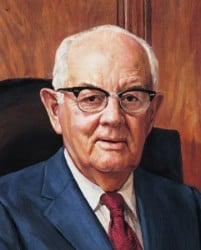
Spencer W. Kimball Portrait

“If we like luxuries or necessities more than we like obedience, we will miss the blessings which he would like to give us.”

Spencer W. Kimball

Topics: , ,

“If there is any one thing that will bring peace and contentment into the human heart, and into the family, it is to live within our means. And if there is any one thing that is grinding and discouraging and disheartening, it is to have debts and obligations that one cannot meet.”

Heber J. Grant  |  Gospel Standards, Salt Lake City: Improvement Era, 1941, p. 111

Topics: ,

“Most books contained in libraries of the world were authored for contemporary readers. And they were generally written for profit, with royalties accruing from successful sales.

“Not so with the Book of Mormon. It was written anciently for our day. It reveals the endless Lordship of Jesus Christ in accounts of two ancient American dispensations, preserved for the benefit of us who live in this dispensation of the fulness of times. Certainly no royalties came to its authors. In fact, they paid dearly for their privilege of participation. What motivated them? Their devotion to God! The book’s four major writers—Nephi, Jacob, Mormon, and Moroni —were all eyewitnesses of the Lord, as was its martyred translator, the Prophet Joseph Smith.”

Russell M. Nelson  |  "A Testimony of the Book of Mormon," Conference October 1999

Topics: , ,

“Make up your mind to be happy – even when you don’t have money, even when you don’t have a clear complexion, even when you don’t have the Nobel Prize. Some of the happiest people I know have none of these things the world insists are necessary for satisfaction and joy. Why are they happy? I suppose it is because they don’t listen very well. Or they listen too well – to the things their hearts tell them. They glory in the beauty of the earth. They glory in the rivers and the canyons and the call of the meadowlark. They glory in the love of their families, the stumbling steps of a toddler, the wise and tender smile of the elderly. They glory in honest labor. They glory in the scriptures. They glory in the presence of the Holy Ghost. One thing I know for certain: the time we have here goes by far too quickly. Don’t waste any more time sitting on the bench watching life pass you by.”

Joseph B. Wirthlin  |  “Lessons Learned in the Journey of Life,” Ensign, May 2001, p. 35

Topics: , ,

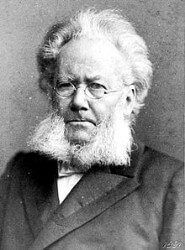
“Money may be the husk of many things, but not the kernel. It brings you food, but not appetite; medicine, but not health; acquaintances, but not friends; servants, but not faithfulness; days of joy, but not peace or happiness”

Henrik Ibsen  |  In The Forbes Scrapbook of Thoughts on the Business of Life, New York: Forbes, Inc., 1968, p. 88

Topics: ,

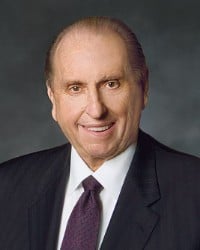
Thomas S. Monson

“Some foolish persons turn their backs on the wisdom of God and follow the allurement of fickle fashion, the attraction of false popularity, and the thrill of the moment. Their course of conduct so resembles the disastrous experience of Esau, who exchanged his birthright for a mess of pottage.

“To illustrate, may I share with you the results of a survey conducted by a reputable organization and reported in a national magazine.2 The survey was entitled, “Would You, for Ten Million Dollars?” Let me ask you the same questions which were asked in the survey:

For 10 million dollars in cash, would you leave your family permanently?
Would you marry someone you didn’t love?
Would you give up all your friends permanently?
Would you serve a year’s jail term on a framed charge?
Would you take off your clothes in public?
Would you take a dangerous job in which you had a 1-in-10 chance of losing your life?
Would you become a beggar for a year?

“Of the people polled, 1 percent would leave their families, 10 percent would marry lovelessly, 11 percent would give up friends, 12 percent would undress in public, 13 percent would go to jail for a year, 14 percent would take the risky job, and 21 percent would beg for a year.

“Where money, rather than morality, dictates one’s actions, one is inclined away from God. Turning away from God brings broken covenants, shattered dreams, vanished ambitions, unfulfilled expectations, crushed hopes, and ruined lives.”

Thomas S. Monson  |  "Decisions Determine Destiny"

Topics: , ,

“Twelve years ago President Ezra Taft Benson delivered a powerful conference address declaring that pride is “the universal sin, the great vice.” (“Beware of Pride,” Ensign, May 1989, p. 6) He taught that pride is essentially competitive in nature and made reference to his quote from C. S. Lewis: “Pride gets no pleasure out of having something, only out of having more of it than the next man. We say that people are proud of being rich, or clever, or good-looking, but they are not. They are proud of being richer, cleverer, or better-looking than others. If every one else became equally rich, or clever, or good-looking there would be nothing to be proud about. It is the comparison that makes you proud: the pleasure of being above the rest. Once the element of competition has gone, pride has gone. (Mere Christianity, 1960, p. 95 [or 109-110])”

Marlin K. Jensen  |  “To Walk Humbly with Thy God,” Ensign, May 2001, p. 10

Topics: , , ,

“Let me promise you here today that if the Latter-day Saints will honestly and conscientiously from this day forth, as a people, keep the monthly fast and pay into the hands of their bishops the actual amount that they would have spent for food for the two meals from which they have refrained . . . we would have all the money necessary to take care of all the idle and all the poor.”

Harold B. Lee  |  Teachings of the Presidents of the Church, Harold B. Lee, p. 182

Topics: ,

“Many today trade away their integrity for a very small price tag. A person who shoplifts for a candy bar, or makeup, or jewelry trades priceless integrity for a meager gain. A person who falsifies a tax return by not reporting income or claiming invalid deductions compromises valued integrity for a pittance of unpaid income tax. One who avoids paying bills promptly for goods or services received exchanges cherished integrity for a perceived temporary advantage. Husbands or wives who are unfaithful to their spouses trade their prized integrity for a fleeting moment of mirth. Integrity is so precious that it is beyond price; it is invaluable.

Joseph B. Wirthlin  |  “Personal Integrity,” Ensign, May 1990, 30–31.

Topics: , ,

“Do not leave yourself or your family unprotected against financial storms. … Build up savings.”

Ezra Taft Benson  |  Pay Thy Debt, and Live …, Brigham Young University Speeches of the Year (28 Feb. 1962), 10.

Topics:

“One of the most common of all sins among worldly people is relying on and then boasting in the arm of flesh. This is a most serious evil. It is a sin born of pride, a sin that creates a frame of mind which keeps men from turning to the Lord and accepting his saving grace. When a man knowingly or unknowingly engages in self-exultation because of his riches, his political power, his worldly learning, his physical prowess, his business ability, or even his works of righteousness, he is not in tune with the Spirit of the Lord. We would all do well to take a lesson from the Savior, who repeatedly acknowledged and gave credit to the Father in all things. Indeed, that precedent was set in the premortal council when Jesus Christ pledged the fruits of all he might himself accomplish to go to the Father: “And the glory be thine forever.” (Moses 4:2)

Marvin J. Ashton  |  “Neither Boast of Faith Nor of Mighty Works,” Ensign, May 1990, p. 65

Topics: , , , ,

Thomas S. Monson

“Happiness does not consist of a glut of luxury, the world’s idea of a “good time” Nor must we search for it in faraway places with strange sounding names. Happiness is found at home.”

Thomas S. Monson  |  Hallmarks of a Happy Home, Ensign October 2001

Topics: , ,

“I appeal to the Latter-day Saints to be honest with the Lord and I promise them that peace, prosperity and financial success will attend those who are honest with our Heavenly Father. … When we set our hearts upon the things of this world and fail to be strictly honest with the Lord we do not grow in the light and power and strength of the gospel as we otherwise would do.”

Heber J. Grant  |  Conference Report, Oct. 1929, pp. 4–5

Topics: ,

“Now this wickedness of pride and haughtiness does not refer to wealth or to money, for Paul said that not money itself, but “the love of money is the root of all evil.” (1 Timothy 6:10) Whenever we love money, status, possessions, or position more than righteousness, this is that false pride which must be avoided as the plague. That is why the Lord told us that riches, per se, are not wicked and that we could even seek for riches if we do so with proper intent.”

Theodore M. Burton  |  “A Disease Called Pride,” BYU Speeches of the Year, October 13, 1971, p. 2

Topics: ,

Spencer W. Kimball Portrait

“The Lord has blessed us as a people with a prosperity unequaled in times past. The resources that have been placed in our power are good, and necessary to our work here on the earth. But I am afraid that many of us have been surfeited with flocks and herds and acres and barns and wealth and have begun to worship them as false gods, and they have power over us. Do we have more of these good things than our faith can stand? Many people spend most of their time working in the service of a self-image that includes sufficient money, stocks, bonds, investment portfolios, property, credit cards, furnishings, automobiles, and the like to guarantee carnal security throughout, it is hoped, a long and happy life. Forgotten is the fact that our assignment is to use these many resources in our families and quorums to build up the kingdom of God.”

Spencer W. Kimball  |  Ensign, June 1976, p. 4

Topics:

Spencer W. Kimball Portrait

“Sometimes we have been a bit penurious and figured that we had for breakfast one egg and that cost so many cents and then we give that to the Lord. I think that when we are affluent, as many of us are, that we ought to be very, very generous. . . .I think we should . . . give, instead of the amount saved by our two meals of fasting, perhaps much, much more – ten times more when we are in a position to do it.”

Spencer W. Kimball  |  Conference Report, April 1974, p. 184

Topics: ,